Walk into a supermarket in Germany, the UAE, Australia, or the United States and you will almost certainly buy something that was not made by the brand on the label. The product inside the jar, tin, or pouch was manufactured by a specialist food producer — someone with the facility, certifications, and supply chain expertise to produce at scale — and then packaged under the retailer’s own brand name.
This is private label food manufacturing. And it is one of the fastest-growing business models in global FMCG retail.
For entrepreneurs looking to launch their own food brand, for importers wanting to differentiate their product range, and for retail chains seeking cost-efficient own-label programs — private label packaged food opens the door to building a brand without building a factory. In this article, we explain exactly how private label food manufacturing works for international B2B buyers, what to look for in a manufacturing partner, and how Aspire International supports private label programs from concept to shelf across 40+ countries.
What Is Private Label Food Manufacturing?
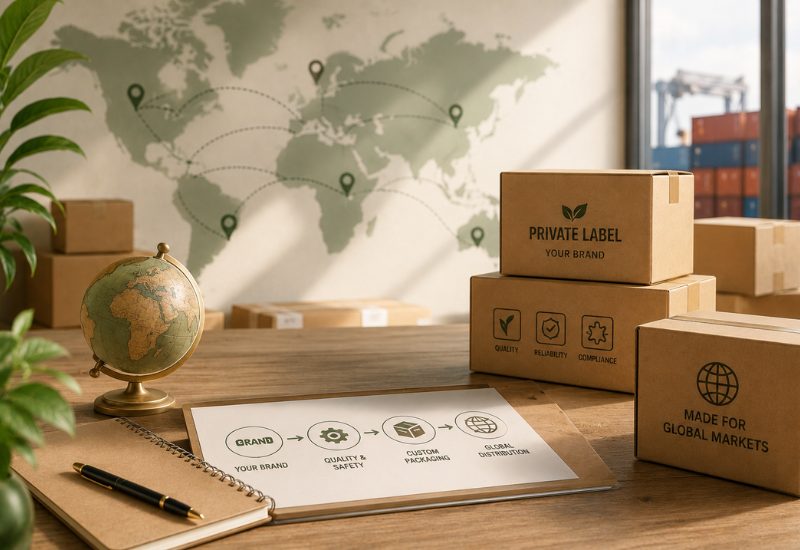
Private label food manufacturing — also called OEM (Original Equipment Manufacturing), white label manufacturing, or contract food manufacturing — is a commercial arrangement where a manufacturer produces food products to a buyer’s specification, which are then sold under the buyer’s own brand name.
The manufacturer handles:
- Product formulation and ingredient sourcing
- Manufacturing, quality control, and food safety compliance
- Packaging in the buyer’s chosen format
- Regulatory documentation for the target export market
- Export logistics
The buyer (importer, distributor, retailer, or brand owner) handles:
- Brand identity — name, logo, label design, brand story
- Market distribution and sales
- Customer relationships in their country
Neither party needs to duplicate the other’s expertise. The manufacturer specialises in making. The buyer specialises in selling.
Private Label vs. Own Brand vs. White Label — What's the Difference?
These terms are often used interchangeably but have subtle distinctions:
Private Label — a product manufactured exclusively for one buyer, typically with a unique formula, packaging specification, and label. Common in supermarket own-label programs (e.g. Tesco’s own honey range).
White Label — a standard, off-the-shelf product manufactured in volume, sold to multiple buyers who each apply their own branding. Faster to launch, lower MOQs, less differentiation.
OEM Manufacturing — a more technical term from the manufacturing industry, meaning the same concept: one company manufactures a product that another company sells under their own brand.
For international B2B buyers, private label typically implies a higher degree of customisation — your own label, your own packaging format, potentially your own formula. White label is faster and simpler but offers less brand distinction.
Why Is Private Label Packaged Food Growing in International B2B Markets?
Several converging forces are driving the growth of private label food globally:
Retail margin pressure. Supermarkets globally are expanding own-label programs because private label products generate significantly higher margin than branded equivalents — typically 25–40% higher gross margin per unit for the retailer.
Consumer trust in own-label has matured. A generation ago, private label meant low quality. Today, premium own-label products from Costco’s Kirkland Signature to Marks & Spencer’s Food range command loyalty and price premiums. The stigma is gone.
E-commerce brand creation. Platforms like Amazon, Shopify, and regional B2C marketplaces have dramatically lowered the barrier to launching a food brand. An entrepreneur with a private label manufacturer and a brand identity can be selling in 30 countries within months.
Post-pandemic supply chain diversification. International buyers who previously sourced from a single market are actively building alternative supply relationships — and India’s food manufacturing sector, with its BRCGS and FSSC 22000 certified facilities, has emerged as a credible alternative to European and North American production.
Which Food Categories Dominate Private Label in International Markets?
The categories with the highest private label penetration globally are precisely the categories where Aspire Internatioal operates:
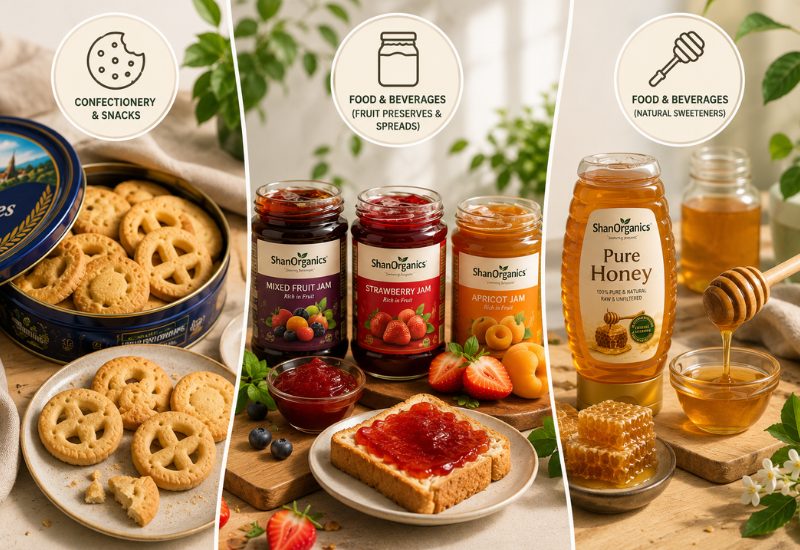
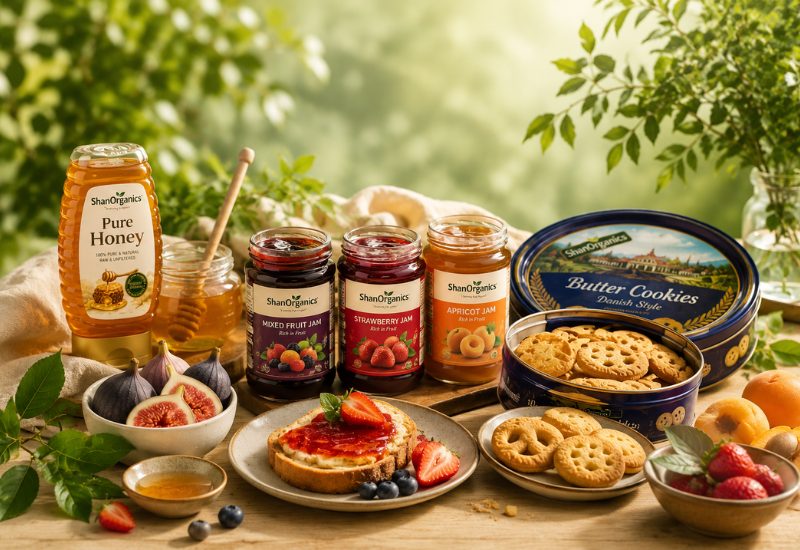
- Honey — one of the most heavily private-labeled food products worldwide. Most supermarket own-label honey programs source from contract manufacturers in India, Ukraine, Argentina, or Eastern Europe.
- Jams and spreads — a classic own-label category. Supermarkets globally have strong own-label positions in jams.
- Cookies and biscuits — particularly the Danish butter cookie format, which has strong demand in gift and seasonal retail globally and is heavily sourced from Asian manufacturers under private label.
What Does a Private Label Food Program Actually Involve? Step by Step
For a buyer new to private label food sourcing, the process typically follows these stages:
Step 1 — Define Your Product and Market
Before approaching any manufacturer, a buyer should be clear on:
- Which product category (honey, cookies, jam, etc.)
- Target market (country, retail channel, consumer segment)
- Pack size and packaging format
- Key certifications required (Halal for Middle East, Kosher for USA/Israel, BRCGS for UK supermarkets, USFDA registration for USA)
- Price positioning (premium, mid-market, value)
This brief allows a manufacturer to confirm whether they can meet the specification and which certifications apply.
Sample and Evaluate
A credible private label manufacturer will send product samples before any commercial discussion. Samples allow the buyer to evaluate taste, texture, consistency, and packaging quality. At Ess Pee Quality Products, we send complimentary samples to qualified buyers in their preferred packaging format.
Packaging and Label Development
Once the product is approved, the buyer’s brand identity is applied. This includes:
- Label design (buyer provides artwork, or manufacturer assists)
- Packaging format selection (glass jar, tin, pouch, etc.)
- Language and regulatory compliance for target market (ingredient declarations, nutrition panels, allergen statements)
- Barcode / GTIN registration
Manufacturing, Quality Control, and Documentation
The manufacturer produces the first commercial order. A credible certified manufacturer will provide:
- Certificate of Analysis (CoA) for each batch
- Product specification sheets
- Shelf life and storage data
- Relevant certification documentation (BRCGS, HALAL, Kosher, USFDA as applicable)
Export, Customs, and Logistics
The manufacturer handles export documentation (commercial invoice, packing list, certificate of origin, phytosanitary/health certificates as required). The buyer manages import customs and last-mile distribution in their market.
What to Look for in a Private Label Food Manufacturer for International B2B
Not all manufacturers can support genuine international private label programs. Key criteria:
Food safety certification — at minimum BRCGS, FSSC 22000, or ISO 22000. For specific markets: USFDA registration for USA, HALAL certification for Middle East and Muslim-majority markets, Kosher for USA and Israel.
Export track record — has the manufacturer shipped to your region before? Do they understand import documentation requirements for your country?
Packaging flexibility — can they support your preferred format, weight, and label specification? Can they accommodate low MOQs for launch orders?
Regulatory knowledge — does the manufacturer understand labelling requirements in your market? (Ingredient declaration order, nutrition panel format, allergen bold formatting, country-specific claims restrictions)
Transparency — are they willing to share full ingredient specifications, CoAs, audit reports, and certification documents before you place an order?
How Aspire International Supports International Private Label Programs
Aspire International is a BRCGS AA+ and FSSC 22000 certified food manufacturer based in Mohali, India, with a 15+ year track record of supplying private label programs to buyers in 40+ countries including the USA, UAE, Saudi Arabia, Israel, UK, Germany, France, Singapore, Australia, and Canada.
Our private label capability covers three core product lines:
Natural Honey — available in glass jars, PET bottles, squeeze formats, teddy bear bottles, and bulk. Varieties include multiflower, acacia, wildflower, jamun, litchi, and orange blossom. Sizes from 50g to 5kg. BRCGS AA+, USFDA, HALAL, Kosher certified.
Danish Style Butter Cookies — available in round metal tins (114g to 908g), stand-up pouches, box packs, and floor display cartons. Multiple flavour variants. BRCGS AA+, Kosher certified. Shelf life 18 months.
Fruit Jams and Spreads — available in glass jars (250g to 2kg) and HORECA packs (5kg). Standard and sugar-free ranges. Natural colour and flavour formulations. FSSC 22000, USFDA, BRCGS certified.
We support buyers with label design assistance, product mockups, regulatory compliance guidance for target markets, and flexible MOQs designed to support new and growing brands alongside established import programs.
To request samples or discuss your private label requirements, contact us at [email protected] or visit esspees.com.