If you are a category manager at a supermarket chain, an importer filing trade documentation, an exhibitor at Gulfood or Anuga, or an entrepreneur setting up an Amazon store — you will at some point need to answer one deceptively simple question: which category does this product belong to?
For most everyday products the answer is obvious. But food and beverage classification systems — whether for retail shelf placement, trade fair registration, customs HS codes, or B2B platform listings — are surprisingly nuanced. Honey, Danish butter cookies, and fruit jams each occupy specific, well-defined positions within the global FMCG taxonomy. And getting the category right matters: it affects which buyers you reach, which trade fairs you should exhibit at, which B2B platforms to list on, and how your products are merchandised in retail.
This article walks through the category positioning of each of our three core product lines, explains how international classification systems treat them, and gives importers and retail buyers the clarity they need for sourcing and placement decisions.
Where Does Honey Fall in Food Category Classification?
Retail Category — Natural Sweeteners / Honey & Syrups
In supermarket retail, honey is universally classified within the Breakfast & Spreads or Sweet Spreads & Condiments department, under the sub-category of Honey, Syrups & Sweeteners. In larger stores, honey may have its own dedicated bay within Breakfast Foods.
Honey’s retail neighbours are: maple syrup, agave nectar, golden syrup, molasses, and increasingly plant-based honey alternatives. In health food sections and premium grocery, honey often appears separately as a Natural Health & Wellness product.
Trade Fair Classification — Natural Foods / Organic & Health Products
At major international food trade fairs, honey is typically exhibited under:
- Natural, organic, and health food products
- Sweeteners and sugar alternatives
- Gourmet and specialty foods (for artisan and monofloral varieties)
At Gulfood Dubai, honey manufacturers exhibit primarily in the Commodities and Natural & Organic segments. At Anuga Cologne, honey falls under Anuga Fine Food and Anuga Drinks (for infused honey beverages). At ISM Cologne (the world’s leading sweets and snacks fair), honey-coated nuts and honey confectionery appear — but plain honey itself is not typically an ISM product.
HS Code — Chapter 04
Under the international Harmonised System, honey is classified under Chapter 04: Dairy produce; birds’ eggs; natural honey; edible products of animal origin. The specific code is 0409 — Natural honey.
Sub-classifications allow distinction between:
- 0409.00.10 — Bees’ honey (most common)
- 0409.00.90 — Other natural honey
This HS code is critically important for import documentation. Buyers sourcing honey from India will use 0409 on customs declarations, and the applicable duty rate will vary by destination country and any applicable preferential trade agreements.
B2B Platform Category — Food & Grocery / Natural Sweeteners
On B2B sourcing platforms, honey is typically listed under:
- Food & Grocery → Condiments & Spreads → Honey & Syrups
- Or Health & Natural Foods → Natural Sweeteners
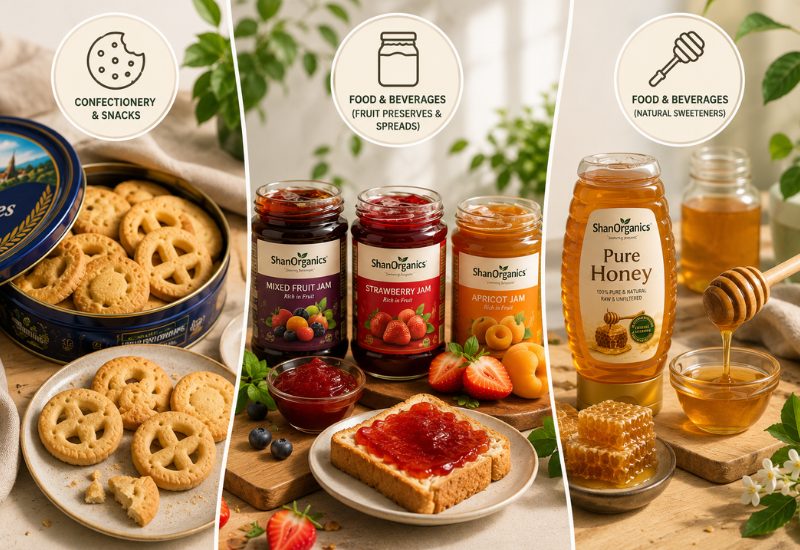
Summary for Honey: Honey is a Food & Grocery product, sub-category Sweet Spreads and Natural Sweeteners. It is not Confectionery. It is not a Beverage. It sits consistently in the Breakfast, Spreads, and Condiments aisle across all global retail markets.
Where Do Danish Butter Cookies Fall in Food Category Classification?
This is where the answer is most interesting — because Danish butter cookies genuinely straddle two categories.
Retail Category — Biscuits & Cookies (within Confectionery & Snacks) OR Sweet Bakery (within Grocery)
In supermarket retail, Danish butter cookies appear in one of two locations depending on the store’s category architecture:
Option 1: Biscuits & Cookies aisle — within the Confectionery, Snacks & Biscuits department. This is the most common placement in UK, European, and Australian supermarkets. Their shelf neighbours: digestives, shortbread, chocolate biscuits, wafers, and other sweet biscuits.
Option 2: Gift Foods / Seasonal Confectionery — Danish butter cookies in decorative tins are frequently merchandised in Seasonal Gift Foods during Christmas, Ramadan/Eid, and Chinese New Year. The tin format positions them as a gifting product sitting in seasonal aisles alongside chocolates, biscuit assortments, and specialty confectionery.
This dual placement reflects the Danish butter cookie’s unique market position: it is simultaneously an everyday snacking biscuit and a premium gifting product, depending entirely on the packaging format and retail context.
HS Code — Chapter 19
Butter cookies are classified under Chapter 19: Preparations of cereals, flour, starch or milk; pastrycooks’ products. The heading is 1905 — Bread, pastry, cakes, biscuits and other bakers’ wares:
- 1905.31 — Sweet biscuits (the primary classification for Danish-style butter cookies)
- 1905.32 — Waffles and wafers
- 1905.90 — Other bakers’ wares
Danish butter cookies in tins are consistently classified as 1905.31 — Sweet biscuits in most markets. Buyers should confirm with their customs broker as some markets apply 1905.90 for certain cookie formats.
B2B Platform Category — Confectionery & Snacks / Biscuits & Cookies
On B2B sourcing platforms, butter cookies are listed under:
- Food & Grocery → Confectionery & Snacks → Biscuits & Cookies
- Or Snacks & Convenience Foods → Sweet Biscuits
Summary for Danish Butter Cookies: Butter cookies belong in Confectionery & Snacks, sub-category Biscuits & Cookies — with a secondary position in Gift Foods for tin-format SKUs. They are the only product among our three lines that sits in Confectionery rather than Grocery/Spreads.
Category Summary Table — At a Glance for Importers and Buyers
Natural Honey | Fruit Jams & Spreads | Danish Butter Cookies | |
|---|---|---|---|
Retail Department | Grocery — Breakfast & Spreads | Grocery — Breakfast & Spreads | Confectionery & Snacks — Biscuits |
Sub-category | Sweet Spreads / Natural Sweeteners | Jams, Preserves & Spreads | Biscuits & Cookies / Gift Foods |
Trade Fair Segment | Natural Foods / Commodities | Grocery & Ambient | Confectionery & Snacks |
HS Code (Chapter) | Chapter 04 (0409) | Chapter 20 (2007) | Chapter 19 (1905.31) |
B2B Platform Category | Food & Grocery | Food & Grocery | Confectionery & Snacks |
ISM Cologne relevant? | No | No | Yes |
Gulfood segment | Commodities / Natural Foods | Culinary & Condiments | Confectionery & Snacks |
Eco-Friendly Sweetener
Getting category positioning right affects:
Which buyer you need to speak to. In most supermarket chains, the honey and jam buyer is a different person from the biscuits and confectionery buyer. Sending a cookie pitch to a spreads buyer wastes everyone’s time.
Which trade fairs to attend. Honey and jam buyers are concentrated at Gulfood, Anuga, and FHA (Food & Hotel Asia). Cookie and biscuit buyers are also present at ISM Cologne and PLMA. If you source all three categories from one manufacturer — as many of our private label partners do — you can consolidate sourcing conversations efficiently.
Which B2B platforms to list on. Category trees on Alibaba, Torg, and Global Sources determine search visibility. A honey product listed under the wrong category simply will not appear in buyer searches.
Shelf placement negotiations. For retail buyers launching a private label range, understanding which category each product competes in determines slotting, shelf adjacency, and which branded competitors you will be positioned against.
At Ess Pee Quality Products, we help our private label partners understand the category positioning of their products from day one — because the right placement is the foundation of a successful retail program.
To discuss sourcing across our three product categories, visit esspees.com or contact [email protected].